Dozens of foreign nationals move to Barcelona every year. It’s a drastic change in terms of language, climate, culture, customs… and also tax obligations. Where and how you pay tax is a recurring concern that needs to be sorted out in the first few days of your stay. It’s therefore important to understand that tax residency in Spain is the concept that determines whether the tax authorities will require you to pay tax on all your worldwide income or only on what you earn here.
Contrary to what many expats believe, it does not depend on holding a TIE, being registered on the local council’s register, or the expat’s nationality; it depends on specific criteria set out by law.
At Taxmind, we have been working for years at to resolve all these issues for foreign residents as a leading international consultancy in Barcelona. That is why we want to explain in detail and set out everything that tax residency in Spain entails, starting with the criteria applied by the Tax Agency.
If you have any queries or require specific advice on this matter, please do not hesitate to contact our firm or leave us a comment after reading this.
Tax residence in Spain: why it is so important for an expat
Tax residence in Spain refers to the status that determines in which country (Spain) you must pay tax on your total income (salaries, pensions, rental income, dividends, interest or capital gains from the sale of assets), wherever that income is sourced. Each country has its own rules for determining who is a resident, and in Spain these rules are set out in Law 35/2006 on Personal Income Tax.
A common misunderstanding amongst foreigners arriving in Barcelona is to confuse tax residence with other administrative procedures. This table summarises the differences:
| Concept | What it certifies | Who handles it | Does it make you a tax resident? |
|---|---|---|---|
| NIE | Your foreigner identification number | National Police / Immigration | No |
| TIE or EU registration certificate | Your right to reside legally in Spain | Immigration Office / National Police | Not on its own (it is an indication) |
| Registration on the municipal register | Your address in the municipality | Town Hall (in Barcelona, the OACs) | No (it is an indication) |
| Tax residence | Where you pay tax on your worldwide income | This is derived from the law (Section 9 of the Personal Income Tax Act); the Tax Authority certifies it | Yes |
Resident or non-resident for tax purposes
Essentially, foreign tax residents are liable for personal income tax on their worldwide income, at a progressive rate which, in Catalonia, can reach 50 per cent in the highest brackets of the general tax base. In addition, they are subject to reporting obligations such as Form 720 and to Wealth Tax on all their assets.
In contrast, non-residents are only taxed on income earned in Spain via the IRNR (Non-Resident Income Tax), usually at a fixed rate: 19 per cent if you are resident in the EU or the EEA, and 24 per cent in all other cases for most types of income. You can find more detailed information on our non-resident tax service page.
The legal criteria: Article 9 of the Personal Income Tax Act
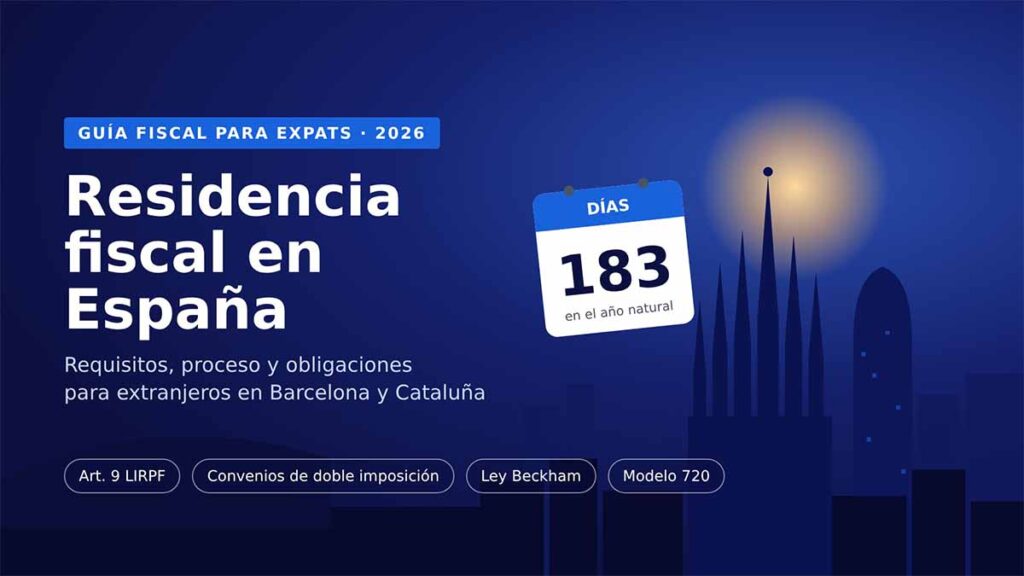
Tax residency in Spain is neither applied for nor chosen: you either have it or you do not, depending on whether you meet the legal criteria in each calendar year. The Tax Agency applies three rules, and you only need to meet one of them.
1️⃣ Staying in Spain for more than 183 days during the calendar year
This is the best-known criterion. The days spent physically present in Spain between 1 January and 31 December are counted; they do not have to be consecutive, and rolling 12-month periods are not used.
Two important points to bear in mind:
Sporadic absences count as days spent in Spain
A two-week trip to your country of origin or a holiday does not interrupt your stay, unless you can prove your tax residence in another country by means of a certificate from that country’s tax authority.
If you move to a tax haven
Which would be a jurisdiction classified as non-cooperative. In such cases, the tax authorities may require you to prove that you have spent at least 183 days there during the year.
2️⃣ Having the centre of your economic interests in Spain
Even if we spend fewer than 183 days in Spain, we will be considered residents if the basis of our economic activities or interests lies here: for example, if the main source of income is a business or a job in Spain, or if the majority of our assets are held here. This is an assessment criterion which the tax authorities analyse using supporting evidence (contracts, invoices, bank statements, property deeds).
3️⃣ Presumption based on family residence
You are presumed to be a tax resident if your spouse (with whom you are not legally separated) and any dependent minor children habitually reside in Spain. This is a rebuttable presumption: you can rebut it by proving, with a tax certificate, that you are resident in another country.
How to prove the number of days spent and economic interests in relation to tax residence
In an audit, the burden of proof usually falls on the taxpayer. It is advisable to keep important documents relating to a person’s tax residence in Spain for at least four years (the general limitation period), such as:
- Tenancy agreement or deed of ownership for the property, and utility bills.
- Airline tickets, boarding passes and card transaction statements showing where the individual was.
- Employment contract, registration with Social Security or as a self-employed person.
- Certificate of registration on the municipal register, children’s school enrolment documents and health card.
- Tax residence certificates issued by other countries, if available.
Dual tax residence: when two countries claim you as a resident
It is common for an expat to be a tax resident in Spain under Spanish law and, at the same time, a resident in their country of origin under that country’s law. To avoid paying tax twice on the same income, Spain has signed a wide network of double taxation agreements (more than 90), based on the OECD Model. Article 4 of this model sets out tie-breaking rules which are applied in the following order:
- Permanent home: you are resident where you have a permanent home at your disposal.
- Centre of vital interests: if you have a home in both countries, the one with which you have the closest personal and economic ties takes precedence.
- Habitual residence: if the above cannot be determined, the country where you habitually reside.
- Nationality: if you habitually live in both countries or in neither.
- Mutual agreement procedure: as a last resort, the two tax authorities resolve the matter by mutual agreement.
For the treaty to protect the taxpayer, a certificate of tax residence issued by the competent authority “for the purposes of the treaty” is required. If there is no treaty with the country of origin, the taxpayer may claim the international double taxation relief on personal income tax for taxes paid abroad, subject to the limits set out in law.
How to establish tax residence in Spain, step by step
Although tax residence in Spain is determined by the facts, as an expat it is in your interest to keep a proper record of your arrival to avoid problems both here and in your country of origin. We will set out exactly which steps to take throughout the process that we follow with our clients in Barcelona at Taxmind:
Obtain your NIE and residence documentation
If you are an EU citizen, you will need the certificate of registration as an EU citizen; if not, you will need the relevant visa or authorisation (work, international remote working, non-lucrative residence, etc.) and the TIE. In Barcelona, these are processed by appointment at the Immigration Office or at National Police stations.
Registering with the local council
In Barcelona, at any Citizen Services Office (OAC). This does not make you a tax resident, but it is a relevant indicator and you will need it for many administrative procedures.
Registering with Social Security
If you are employed by a company, they will do this for you; however, if you are going to be self-employed, you will need to register as a self-employed person and submit form 036 to the tax office. At Taxmind, this is one of the standard services we provide to our clients who are foreign self-employed individuals.
Notifying the Tax Office of your tax address in Spain
If you are not carrying out any economic activity, this is done using form 030 (registration on the census and change of address). It is also advisable to obtain a Cl@ve or digital certificate to deal with the Tax Agency.
Consider the Beckham Law before the deadline passes
If you meet the requirements, you must opt in using Form 149 within six months of registering with Social Security in Spain. If you miss this deadline, you will lose your entitlement to the scheme.
Notify your country of origin of your departure
Always follow their regulations (change of address, deregistration from the tax register, etc.) and keep the documentation, as it will be crucial if that country continues to consider you a resident.
Submit your first income tax return (Form 100, or Form 151 if you are covered by the Beckham Law)
This must be done between April and the end of June of the following year, including worldwide income for the whole year.
Apply for a tax residence certificate when required
This is requested via the Tax Agency’s online portal and is issued if your residence can be deduced from the data held by the Tax Agency. In the first year, if you have not yet filed a tax return, you may need to provide supporting documentation.
Please bear in mind that foreign banks, pension providers, investment platforms and the tax authorities in your country of origin will ask you for your Spanish tax residence certificate so that they can stop withholding tax from your payments. It is usually valid for one year, so it is advisable to renew it each tax year.
The year of arrival and the year of departure: in Spain, there is no pro rata calculation
Tax residence in Spain is determined on the basis of the full calendar year. Generally speaking, there is no such thing as a ‘split year’: you are either a resident for the whole year or you are not. This has very significant tax implications, as we shall now see.
For example, if you arrive in Barcelona on 1 June and stay, you will have spent 214 days there; in other words, you will then be a tax resident for the whole year and, in principle, you would also have to declare in Spain any income earned between January and May in another country (applying the tax treaty and the double taxation relief).
Conversely, if you arrive on 15 September, you will not normally be considered a resident for that year (unless the centre of your economic interests was already in Spain), and your first year as a resident will be the following one.
Another scenario: If you leave Spain halfway through the year, the tax authorities may still consider you a resident unless you provide proof of a new tax residence with a certificate from the other country, as absences are regarded as sporadic.
When leaving Spain, you must also check the exit tax under Article 95 bis of the Personal Income Tax Act. If you have been a resident for at least 10 of the last 15 years and hold shares or holdings with a market value exceeding 4 million euros (or exceeding 1 million if your holding exceeds 25 per cent), you will be liable to tax on unrealised capital gains.
Tax obligations for expats resident in Spain
Being a tax resident involves more than just filing an income tax return. These are the main obligations you need to be aware of:
| Obligation | What it covers | Deadline |
|---|---|---|
| IRPF (Form 100) | All your worldwide income: employment, pensions, rental income, interest, dividends and capital gains. | From April to the end of June of the following year |
| Form 720 | Informative declaration of assets held abroad where a single category (bank accounts, securities/insurance policies or property) exceeds €50,000. | From 1 January to 31 March |
| Form 721 | Virtual currencies held abroad with a value exceeding €50,000. | From 1 January to 31 March |
| Wealth Tax (Form 714) | In Catalonia, if your net assets exceed the €500,000 exemption threshold (your main residence is exempt up to €300,000) or your assets exceed €2 million. | From April to the end of June |
| Temporary Solidarity Tax on Large Fortunes (Form 718) | Net assets exceeding €3 million. | In July |
The first year of tax residence in Spain is when we see the most errors: Form 720 is frequently overlooked because expats still have bank accounts, investments or a property in their home country. Although the penalty regime was relaxed following the ruling of the Court of Justice of the European Union on 27 January 2022, failure to submit it still has consequences.
The Beckham Law: the special regime for posted workers
The special regime for impatriates set out in Article 93 of the Personal Income Tax Act, known as the ‘Beckham Law’, allows anyone who acquires tax residence in Spain by relocating here to be taxed as if they were a non-resident during the year of relocation and the following five years. Key points following the reform of the Start-ups Act (Act 28/2022):
- Not having been a tax resident in Spain in the five years prior to the move.
- Relocation must be due to an employment contract (including international remote working), as a director of a company, for an entrepreneurial activity, or as a highly qualified professional working for start-ups.
- A tax rate of 24 per cent on up to €600,000 of employment income and 47 per cent on any amount exceeding that; income earned abroad is, as a general rule, not taxable in Spain.
- This may be extended to your spouse and children under the age of 25 who relocate with you, provided they meet the requirements.
- It is applied for using Form 149 within six months of registering with Social Security, and is declared annually using Form 151. Taxpayers covered by this scheme do not need to submit Form 720.
Bear in mind that claiming the Beckham Law does not make us non-residents; we continue to have tax residence in Spain, even though we are taxed under special rules. For this reason, for the purposes of tax treaties, some countries will not recognise us as Spanish residents. It is advisable to analyse this before opting in.
Real-life examples where tax residence is the deciding factor
These are some of the cases we most frequently encounter at our Taxmind office in Barcelona regarding tax residence in Spain. The names are fictitious, but the situations are common:
☑️ Remote worker with a digital nomad visa in Gràcia
Anna, a German national, moves to Barcelona in March and works remotely for a company in Berlin. By the end of the year, she has spent more than 183 days in Spain: she is a tax resident in Spain and her salary is taxed here, even though it is paid by a German company. As she had not lived in Spain in the previous five years, she was able to opt for the Beckham Law within the six-month deadline and be taxed at 24 per cent.
☑️ Executive seconded by his company to Barcelona
Marc, a French national, is transferred by his group to the company’s headquarters in the 22@ district. His family moves with him in September. That year, he spends only 110 days in Spain, so he is not a resident for that tax year. However, his income and his family are already in Barcelona: from 1 January of the following year, he will be a resident, and it is advisable to prepare to opt for the Beckham Law and deregister for tax purposes in France.
☑️ British pensioner in Sitges
Peter lives in Sitges all year round and receives a private pension from the UK and a state pension as a former civil servant. As a tax resident in Spain, his private pension is subject to personal income tax in Spain. By contrast, the double taxation agreement with the UK normally reserves the right to tax state pensions to the country that pays them. Furthermore, he should check whether his accounts and investments in the UK require him to submit Form 720.
☑️ An engineer who travels a great deal, but whose family lives in Barcelona
Sofía spends 150 days in Barcelona and the rest working on projects in the Middle East. Her husband and young children live in Sant Cugat. Under the family presumption rule, the tax authorities will consider her a resident unless she provides a tax certificate proving she is resident in another country. Without such a certificate, all her income is taxable in Spain.
☑️ An American with a flat let in the Eixample
John lives in New York and rents out his flat in Barcelona. He is not a tax resident in Spain, so he is only taxed on the rental income via Form 210 at 24 per cent, without being able to deduct the expenses that an EU resident would be able to claim. If he were to move to Barcelona, he would become liable for tax on his worldwide income and would have to coordinate the tax treaty with the US, which taxes its citizens on the basis of nationality.
☑️ Worker leaves Barcelona halfway through the year
Lucia, an Italian national, is moving to Lisbon in April. Although she has only spent 100 days in Spain, if she does not obtain a Portuguese tax residence certificate, the Spanish tax authorities could consider her absence to be sporadic. She must notify the authorities of her change of address (Form 030), keep proof of her move and, if she holds a significant portfolio of shares, check the exit tax.
Tax residence in Barcelona and Catalonia
Being a tax resident in Spain also means being a resident of an autonomous community, and this affects how much tax you pay. According to Article 72 of the Personal Income Tax Act, the community is determined by the one in which the person spends the most days of the year. If you live in Barcelona, Catalan rules apply.
What are these?
Personal Income Tax
The Catalan regional tax bracket is one of the highest in Spain, so proper planning (the Beckham Law, tax deductions, contributions to pension schemes) makes a significant difference.
Wealth Tax
Catalonia applies a minimum exemption of €500,000 (compared to €700,000 under national law), with no general allowance, and rates ranging from 0.21% to 3.48%.
Inheritance and Gift Tax
As a resident of Catalonia, Catalan regulations apply, with their own reductions and allowances – a key consideration if you are going to receive or make gifts to family members.
In-person procedures
Barcelona Immigration Office, Citizen Service Centres for the municipal register, and the Special Delegation of the Tax Agency in Catalonia.
Common mistakes made by expats with tax residence in Spain
The ones we see and deal with most often at Taxmind are these:
- Believing that without a TIE (Foreigners’ Identification Number) or registration on the municipal register, you are not a tax resident. Tax residency in Spain depends on the number of days spent in the country and your financial interests, not on immigration documents.
- Continuing to file tax returns only in their country of origin without applying for a Spanish tax residence certificate. This can result in paying tax twice or having to regularise their tax status in Spain.
- Forgetting to submit Form 720 in the first year, particularly if you have bank accounts, pension schemes or property in your country of origin.
- Missing the six-month deadline under the Beckham Law. This cannot be recovered later.
- Failing to keep proof of the days spent outside Spain if you travel a lot.
- Assuming that, if you arrive halfway through the year, you’re only taxed for the months spent in Spain. If you’re a resident, you’re considered a resident for the whole year.
Frequently asked questions about tax residency in Spain
We’ve summarised most of what we’ve covered on the subject of tax residency in Spain; these are some of the most common questions we answer at our firm on this topic:
☑️ How many days do I have to spend in Spain to be a tax resident?
More than 183 days within the same calendar year (from 1 January to 31 December). They do not have to be consecutive, and sporadic absences count as days spent in Spain unless you can provide a certificate proving that you are a tax resident in another country. Even with fewer days, you may still be considered a resident if your centre of economic interests or your family is in Spain.
☑️ How do I know if I’m a tax resident in Spain?
Check the three criteria set out in Article 9 of the Personal Income Tax Act: spending more than 183 days in the year, having the main centre of your economic interests in Spain, or having your spouse (with whom you are not separated) and dependent minor children here. If you meet any one of these criteria, you are a resident. In cases of doubt or dual residence, the tax treaty with your other country must be applied.
☑️ What is the difference between legal residence and tax residence?
Legal residence (TIE or EU registration certificate) authorises you to live in Spain; tax residence determines where you pay tax on your worldwide income. You can hold a TIE and not be a tax resident, or be a tax resident without yet holding a TIE.
☑️ Can I be a tax resident in two countries at the same time?
Depending on the domestic laws of each country, yes. To resolve this, double taxation agreements apply tie-breaker rules (permanent home, centre of vital interests, habitual abode and nationality). You will need a tax residence certificate ‘for the purposes of the agreement’.
☑️ How do I obtain a certificate of tax residence in Spain?
You can apply via the Spanish Tax Agency’s online portal, using a digital certificate or Cl@ve, in the tax certificates section. It will be issued if the Tax Agency’s records confirm your residence; in the first year, you may need to provide supporting documents (tenancy agreement, council register, Social Security registration).
☑️ Can I choose where to be a tax resident?
No. Tax residence is not a choice: it depends on objective factors (days spent in the country, economic interests, family). What you can do, however, is plan your arrival or departure and document it properly so that the relevant rules are applied.
☑️ If I arrive halfway through the year, do I only pay tax on the months I’m in Spain?
No. If, by the end of the year, you have spent more than 183 days in Spain (or meet another criterion), you are a tax resident for the whole year and must declare your worldwide income from January to December, applying the tax treaty and the double taxation relief to avoid paying tax twice.
☑️ Does registering on the municipal register make me a tax resident?
Not on its own. Registration on the local council’s register is an indicator that the tax authorities take into account, but what determines residency are the number of days spent in the country, the centre of economic interests and family circumstances.
☑️ What happens if I am a tax resident and do not file a tax return in Spain?
The tax authorities may regularise your situation by demanding payment of the outstanding tax, late payment interest and penalties, which generally range from 50 per cent to 150 per cent of the amount owed. If you spot this yourself first, a voluntary supplementary tax return reduces the consequences to surcharges.
☑️ Does the Beckham Law make me a non-resident?
No. Under the Beckham Law, you remain a tax resident in Spain, but you are taxed under rules similar to those for non-residents (24 per cent up to €600,000 and, generally, no tax on foreign income) during the year of your move and the following five years.
Conclusions
Tax residency in Spain is a very serious matter from a tax and fiscal perspective, as we have learnt. We are tax residents in Spain in a calendar year if at least one of these criteria set out in Article 9 of the Personal Income Tax Act is met:
1) We spend more than 183 days on Spanish territory during the year (from 1 January to 31 December).
2) We have our main centre or base of economic activities or interests in Spain.
3) It is presumed (unless proven otherwise) that we are resident if our spouse (unless legally separated) and any dependent minor children habitually reside in Spain.
If we are residents, we are liable for personal income tax on our worldwide income. If we are not residents, we only pay Non-Resident Income Tax (IRNR) on income earned in Spain.
As you can see, the issue of tax residence in our country can be rather complex, which often leads to procedural errors if we are not supervised by expert international advisers. Put your trust in our Taxmind team in Barcelona for meticulous and professional tax and accounting management.